If your child has spent years mastering backflips and beam routines, switching to competitive dance might feel like a big leap. It's actually one of the smoothest athletic transitions a young performer can make. Call 3D Motion Dance Center at (407) 786-0269 to schedule a free evaluation and see exactly where your gymnast fits.
How Does Gymnastics Translate to Competitive Dance?
Gymnasts carry a foundation that most beginner dancers spend years building. Flexibility, core strength, spatial awareness, and the discipline to repeat a skill until it's clean — these traits show up on day one in the dance studio.
Most former gymnasts test into an intermediate-level class within their first 4 to 6 weeks, rather than starting from the very beginning. Their tumbling skills are already competition-ready, and their body control gives them a clear head start in learning choreography. What they're missing is performance quality: the facial expressions, the musicality, and the smooth transitions between movements. Those skills come quickly when a child is already athletic and coachable.
The strength and coordination built through years of gymnastics don't disappear. They show up in cleaner leaps, faster pick-up of combinations, and a natural stage presence that takes time to develop in dancers who haven't had a similar athletic background.
Which Dance Style Should a Former Gymnast Try First?
Three styles tend to work especially well for kids making this transition.
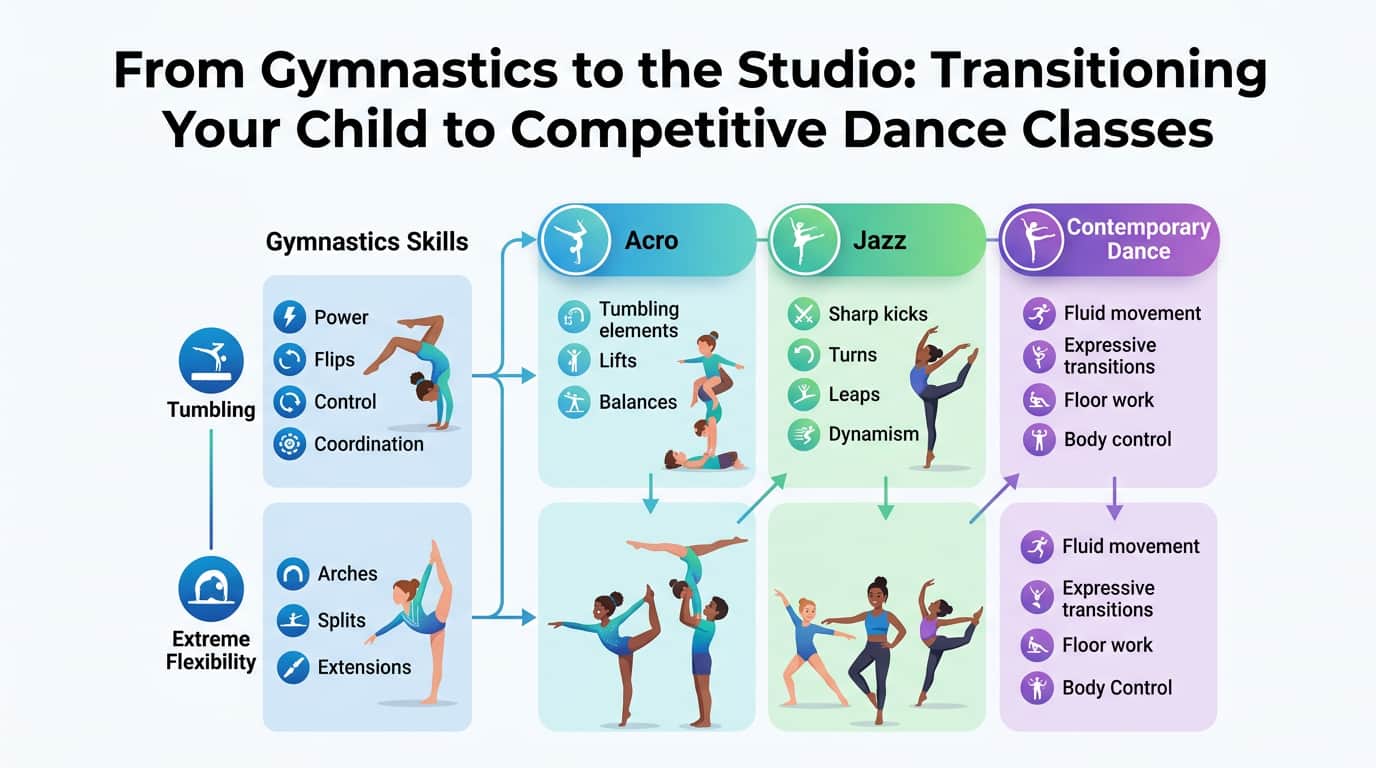
Acro dance is usually the most natural starting point. It blends classical dance technique with acrobatic skills, which means your child's cartwheels, walkovers, and aerials are immediately useful. Acro is one of the most popular crossover styles at child dance lessons programs across Central Florida, and former gymnasts often excel in their first competition season.
Jazz dance builds on the energy and athleticism gymnasts already have. It's fast, expressive, and technically demanding in ways that feel familiar. Jazz emphasizes sharp movements, turns, and extensions — all areas where gymnasts tend to shine.
Contemporary takes a bit more adjustment. It asks dancers to soften their movements, use breath and weight as tools, and tell a story through their body rather than execute a skill. Many former gymnasts find it challenging at first, but deeply rewarding once it clicks. Most make significant progress within 3 to 6 months.
What to Look for in Dance Classes in Apopka, Florida
Not every studio is set up to support a gymnast's transition. Here's what actually matters when you're comparing programs near you.
Look for a studio that offers placement evaluations rather than automatic age-based grouping. A 10-year-old with six years of gymnastics training shouldn't start in a beginner class with children who have never moved in a structured way. Proper placement keeps kids challenged and engaged.
Check whether the studio competes at recognized Florida events like StarQuest or Hall of Fame. Competition exposure helps former gymnasts channel their performance training into a new context, and the feedback from judges accelerates their growth significantly.
Ask about the student-to-teacher ratio. Classes with 15 or fewer students give instructors time to work on individual corrections, which matters a lot during the technical transition period.
At 3D Motion Dance Center in Apopka, placement evaluations are part of the enrollment process. Families near Lake Apopka, the Kelly Park corridor, and the Errol Estate area regularly make the short drive to train there because of the structured competitive program and the community the studio has built.
How Does the Technical Transition Actually Work?
The biggest adjustment isn't physical. It's about releasing control.
Gymnastics trains kids to land with precision, hold their lines rigidly, and present a finished skill. Dance asks for something different: flow between movements, breath that shapes the phrase, and an emotional quality that connects with an audience.
Most former gymnasts take about 6 to 8 weeks to start feeling comfortable with this shift. In our experience working with athletic crossover students, the ones who adjust fastest are those who stop trying to "perform gymnastics beautifully" and start listening to the music as their guide.
Pointed feet are already there. Flexible hips are already there. The main technical work involves softening the upper body, learning port de bras (arm movements), and building genuine facial expression rather than a competition smile. These are teachable skills, and gymnasts tend to absorb them quickly because they're used to correction.
What Gear Do You Need to Switch Out?
Gymnastics gear doesn't all carry over, but some of it does.
Your child's leotards are usually fine for the first few weeks of dance class. Over time, you'll want to add a few dance-specific options: short or long-sleeved styles that allow for a full range of arm movement without the bunching that competitive gymnastics leos can cause.
The bigger change is footwear. Gymnastics uses bare feet or gymnastics slippers. Dance classes require specific shoes by style: ballet flats for ballet and acro foundational work, jazz oxfords or jazz sneakers for jazz class, and lyrical sandals or bare feet for contemporary. Budget roughly $40 to $80 per pair depending on brand, and expect to replace them every 9 to 12 months with active wear.
Competition costumes come from the studio, not the family. Most studios charge between $80 and $200 per costume depending on the category. Your studio director will communicate these costs well ahead of competition season.
How Should Florida Families Prepare for Competition Season?
Competition season in Florida typically runs from January through May, with regional events scattered across Central Florida and occasional travel to Tampa or Jacksonville for larger conventions.
Plan for competition entry fees of $30 to $60 per routine, per event. Most competitive students enter 2 to 4 routines per competition, and a full season might include 3 to 5 events. Families near the Northwest Orange County area, close to Apopka and Zellwood, often find that many regional competitions are within a 45-minute drive, which keeps travel costs manageable.
Rehearsal schedules intensify starting in November. Expect 1 to 2 additional practice sessions per week on top of regular class time during the peak preparation period. This is the time gymnasts often thrive: they're used to the repetition, the physical demand, and the pressure of performing a skill correctly on command.
Talk to your studio director in September or October to get a full picture of your commitment calendar before the season begins. No family should be surprised by the schedule in January.
Ready to Make the Move? Here's Your Next Step
The transition from gymnastics to competitive dance is one that many Florida families navigate successfully every year. The athletic foundation your child has built is real, and it gives them a meaningful advantage as they step into this new performance world.
At 3D Motion Dance Center, we've worked with many crossover athletes and know exactly how to channel gymnastics training into strong dance performance. If you're in the Apopka area or anywhere in Northwest Orange County, call us at (407) 786-0269 to book a placement evaluation. We'll assess your child's current skills, recommend the right class level, and give you a clear picture of what competition season looks like for your family.
Your child spent years earning that athletic foundation. Now it's time to perform with it.