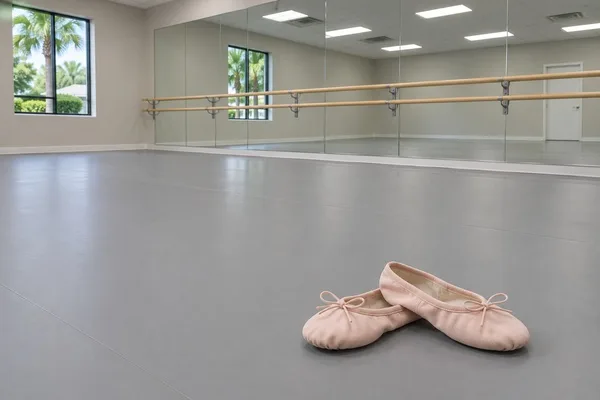
The kind of floor at a dance studio is a big deal because you want it to be able to absorb the impact of repeatedly jumping and landing. When you compare dance studios in Apopka, look past the mirrors and the schedule and ask what your child will land on. A cushioned floor with the right top surface makes every class easier on a growing body.
At 3D Motion Dance Center, we built our studios around that idea. Want to see the floors for yourself? Reach out to our front desk or call (407) 786-0269 to set up a visit.
What Makes a Good Dance Studio Floor?
A good dance floor has two parts: a base that gives a little when a dancer lands, and a top surface built for dance shoes and bare feet. Most parents never see either one, because both look like a plain gray floor.
Ours is a floating floor. It rests on more than 700 high-density foam blocks instead of sitting right on the concrete slab. When a dancer comes down from a jump, the foam takes some of the shock. We chose foam over a traditional sprung floor, which is a wood frame built on top of the regular floor.
On top sits a marley surface, the vinyl dance floor used from recreational classes to professional stages. You can read more about both layers on our why choose us page.
Compare that with a studio set up in a converted storefront along US 441, where the dance floor may be thin vinyl laid straight over concrete. From the doorway, the two rooms look the same. Under your child's feet, they feel completely different.
Why Does the Floor Matter for Growing Joints?
Dance asks kids to jump, land, and turn over and over, several times a week. A floor that gives a little means your child's knees, ankles, and back are not taking every landing on their own.
Think about a single class. A beginner might do dozens of small hops, skips, and leaps in an hour, and an older student adds bigger jumps and turns. Every one of those ends with a landing. Dancing all that on hard concrete is a lot of repeated stress for a body that is still growing.
The top surface matters just as much. Marley gives what we call controlled slip. A dancer can pivot and turn smoothly, but the floor grips enough that feet do not shoot out from under them. That makes a fall less likely. A slick wood floor or a sticky rubber mat can each throw a turn off in the opposite direction.
If your child already spends weekends running bases at the Northwest Recreation Complex, you know how much young joints go through. The dance floor should help with that load, not add to it.
What Should You Look For When You Tour a Dance Studio?
Ask what is under the floor and what the top surface is made of, then look and feel for yourself. A good dance studio is happy to answer both questions in plain terms.
Bring these questions to any studio visit:
- Is the floor floating, sprung, or laid directly on concrete?
- What material is the top layer, and is it the same in every room?
- Are the seams taped flat, with no lifted edges or soft spots?
- Which classes use which rooms, especially for jumps and tap?
Then stand in the middle of an empty studio and bounce on your heels. You should feel a slight give. Walk the room and check for gaps along the walls and worn patches near the center, where most of the landings happen.
Plenty of families from the neighborhoods off Wekiwa Springs Road visit a few studios before they choose. That is smart. Tour our facility online first, then come see the rooms and the floors in person.
How Can Your Child Feel the Difference Before You Sign Up?
The best test is a real class. A free trial lets your child dance on the floor, and it lets you watch how they move and how they feel afterward.
During the trial, watch the landings. Notice whether your child is jumping with confidence or bracing on the way down. Afterward, ask them how the floor felt. Kids are honest critics, and they will tell you whether the room felt good to dance in.
You will also get to meet the teachers, see the class size, and ask your floor questions face to face. A dance studio that put real thought into its floors is usually glad you asked.
Ready to see it in person? Book a free trial class, or contact our team at (407) 786-0269 to schedule a tour of the studio. We would love to show you what your child will be landing on.